Skip to content

The best machine embroidery supplies for 2026

Machine embroidery succeeds or fails on stabiliser. We compare tear-away, cut-away, wash-away and fusible backings, plus hoops, threads and temporary adhesive — and match each backing to a fabric.

What we recommend

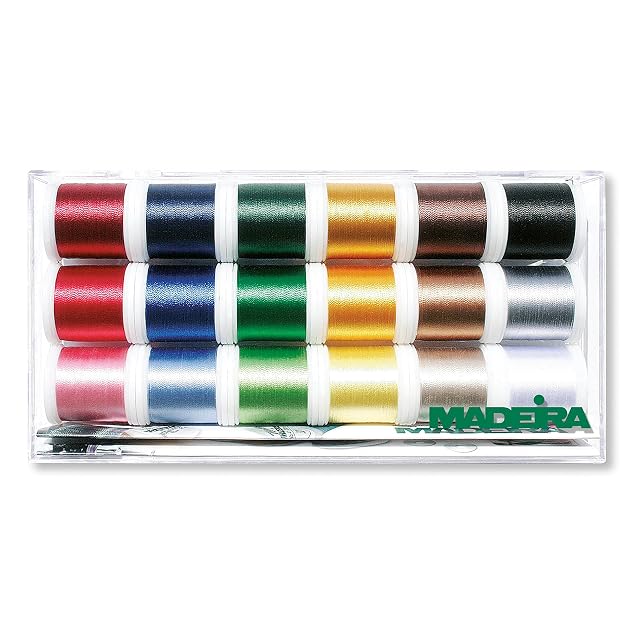
  1. Madeira Polyneon embroidery thread box with eighteen spools

    Madeira Polyneon 40 Embroidery Thread Box, 18 × 400 m

    Eighteen colours of colourfast polyester embroidery thread in one box. One reference on every Amazon store we checked.

    Fibre
    Polyester (Polyneon 40)
    Contents
    18 colours × 400 m
    Amazon reference
    B00405SM4C (all six markets)
    • Polyester survives bleach and hot washes; rayon does not
    • Eighteen colours is enough to start without choosing each one individually
    • Slightly less lustrous than rayon, which some people prefer for display work
    8.4/10 ≈ $55 / £21 / 35 €
    Check price on Amazon
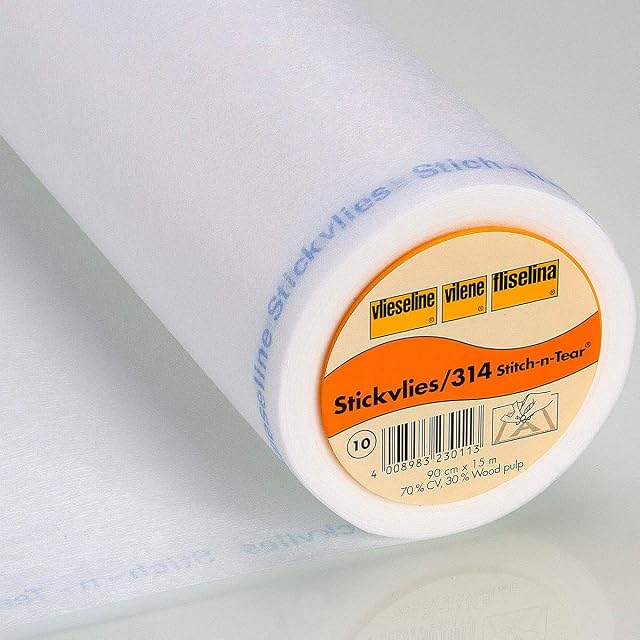
  2. Vlieseline Stitch-n-Tear embroidery stabiliser on the roll

    Vlieseline Stitch-n-Tear Embroidery Stabiliser

    The standard tear-away backing for embroidery on woven fabric. One reference on every Amazon store we checked — and one job it must never be used for.

    Type
    Tear-away stabiliser
    Sold
    Per metre
    Amazon reference
    B0063G531G (all six markets)
    • Removes cleanly from woven fabric with no residue
    • Cheaper and quicker than cut-away for the jobs it suits
    • Wrong for knits — see the warning below
    7.8/10 ≈ $59 / £7 / 4 €
    Check price on Amazon

Who each type suits

Hand embroidery
A hoop, a suitable needle and stranded cotton are enough. One of the least expensive textile hobbies to take up.
Machine embroidery
Stabiliser is the decisive supply, more than the threads. A poor stabiliser ruins a design whatever the machine.
Cross stitch
Aida fabric and its thread count per centimetre decide the finished size of the design. The parameter to check before starting.

The trade-offs to weigh

Stranded cotton against machine thread
Stranded cotton separates into strands and is worked by hand; machine embroidery thread is continuous and glossy. They are not interchangeable.
Tear-away stabiliser against cut-away
Tear-away comes off easily and supports less; cut-away supports lastingly and stays partly behind the work.
Wooden hoop against plastic
Wood holds thick fabrics better and sometimes marks; a sprung plastic hoop adjusts quickly and grips less firmly.

Questions buyers ask

How many strands of cotton should I use?

Two or three for most stitches, a single one for fine detail. The result changes completely with the number.

Is stabiliser compulsory in machine embroidery?

Practically always. Without it the fabric distorts under the density of stitches and the design closes badly.

Which type of stabiliser should I choose?

Tear-away for stable fabrics, cut-away for knits and dense designs, water-soluble for openwork embroidery.

How do I tension the fabric in the hoop?

Taut without being stretched, above all on jersey. Fabric stretched at hooping gives a distorted design once released.

What is the count of a fabric?

The number of threads per unit of length. The higher it is, the smaller the stitches and the smaller the finished design.

Can I embroider on any fabric?

Almost, with the right stabiliser. Knits and very fine fabrics call for the most preparation.

Do threads fade in the wash?

Quality threads are colourfast; cheap threads can run on the first wash. A test on an offcut is prudent.

What to remember

In machine embroidery, the stabiliser decides the result more than the machine or the threads. By hand, two or three strands of cotton and a hoop are enough — and the fabric is tensioned without ever being stretched, on pain of a distorted design.