Presser foot pressure is the setting most sewers never touch. It controls how firmly the foot presses fabric down onto the feed dogs, and it is the fix for many wavy seams and shifting layers.
What it does
The feed dogs move the fabric; the presser foot holds it against them. Too much pressure stretches fabric as it feeds or marks delicate surfaces. Too little lets fabric slip or feed unevenly.
Where to find it
- A dial or screw on top of the machine, above the needle bar, on many mechanical machines.
- A setting in the menu on some computerized machines.
- Nothing at all on many entry-level machines: the pressure is fixed for medium fabric.
The manual shows the standard setting, usually the middle mark.
When to lower it
- Knits: jersey and rib stretch into waves under full pressure. Lower it and use a jersey needle — see sewing knits on a normal machine.
- Thick layers: denim seams, bags, quilts. Less pressure lets the layers move together instead of the top one being pushed ahead.
- Quilt sandwiches: lower pressure, plus a walking foot, keeps the layers from shifting.
- Velvet and pile: less pressure avoids crushing.
- Free-motion quilting: often the lowest setting, with feed dogs dropped.
When to raise it
- Thin, slippery fabric — chiffon, lining, silk — that does not feed.
- Fabric that slides sideways under the foot.
Without a dial
- A walking foot feeds the top layer with the bottom one, which matters most on layers and quilts.
- A longer stitch helps knits and thick layers.
- Tissue paper under thin fabric gives the feed dogs something to grip.
- Do not push or pull. Guiding is enough.
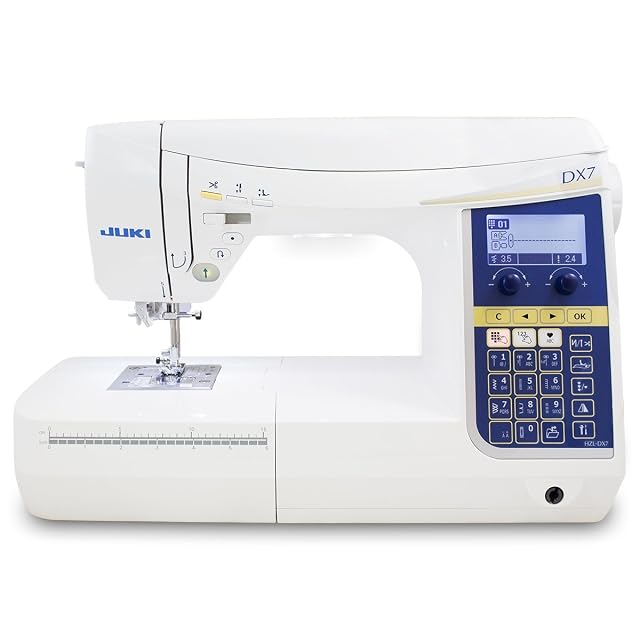
Some machines, such as the Juki HZL-DX7 with box feed, feed layers more evenly by design.
How to test
Sew a seam on two layers of the same fabric, cut the same length. If the ends do not match, or the seam waves, adjust and test again. Note the setting that works for each fabric.
Related settings
Pressure works with stitch length and tension. If a seam still puckers, check how to set thread tension and stitch length and width.
Ruffles and gathers
A ruffler foot gathers fabric mechanically. Our presser feet page compares the feet and sets we checked, including walking feet.
What sewers ask us
Does my machine have adjustable presser foot pressure?
Look for a dial or screw on top of the machine above the needle, or a setting in the menu of computerized models. Many entry-level machines have a fixed pressure.
Why are my knit seams wavy?
Usually too much pressure, which stretches the fabric as it feeds. Lower the pressure, use a ballpoint needle, and do not pull the fabric.
What is the default setting?
The middle or standard mark on the dial, as the manual shows. It suits most medium woven fabric.
Does a walking foot replace pressure adjustment?
It helps more on layers. A walking foot feeds the top layer at the same rate as the bottom, which pressure alone cannot do.
Last reviewed