You do not need a serger to sew knits. A regular sewing machine sews T-shirts, leggings and sweatshirts well with the right needle, the right stitch and a light hand.
1. The needle
Knit fabric is made of loops. A sharp needle can pierce or miss them, causing holes and skipped stitches. Use:
- Ballpoint or jersey needles for most knits: jersey, interlock, sweatshirt fleece. Size 70/10–90/14 depending on weight.
- Stretch needles for very stretchy fabric: swimwear, spandex, activewear.
2. A stitch that stretches
A straight stitch does not stretch and breaks when the seam is pulled. Use:
- A narrow zigzag: width around 0.5–1 mm, length around 2.5 mm. It looks almost straight but stretches.
- A stretch or lightning stitch, if your machine has one.
- A triple stretch stitch for seams under stress, though it is hard to unpick.
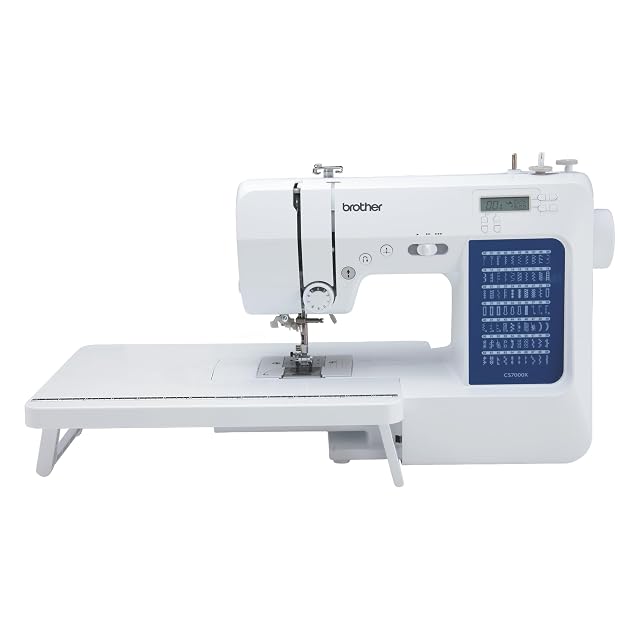
Computerized machines such as the Brother CS7000X list several stretch stitches.
3. Do not pull
Let the feed dogs move the fabric. Pulling or pushing stretches it, and the seam comes out wavy. Support the fabric so its weight does not drag it.
4. Lower the presser foot pressure
If seams still wave, reduce the presser foot pressure, if your machine allows — see presser foot pressure. A walking foot helps on thick or very stretchy knits.
5. Thread
Use polyester thread, such as Gütermann Sew-All, which has some give. Cotton thread can snap in stretched seams.
6. Hems
- Twin needle: two parallel rows on top, a zigzag underneath that stretches. It imitates a coverstitch hem.
- Narrow zigzag close to the fold.
- Stabilize the hem with a strip of knit fusible tape if it ripples.
See how to sew a hem.
7. Necklines and bands
Ribbing and neckbands are stretched slightly as you sew them. Pin them evenly at quarters, stretch the band, not the garment, and sew with a stretch stitch.
Cutting knits
Knits curl and stretch while you cut. Lay the fabric flat on the table without letting it hang over the edge, use pattern weights instead of pins, and cut with a sharp rotary cutter rather than lifting the fabric with shears. Follow the lengthwise grain — the ribs of the knit — so the garment does not twist after washing.
Test first
Sew a test seam on a scrap, then stretch it hard. If stitches pop, use a wider zigzag or a stretch stitch.
When a serger is worth it
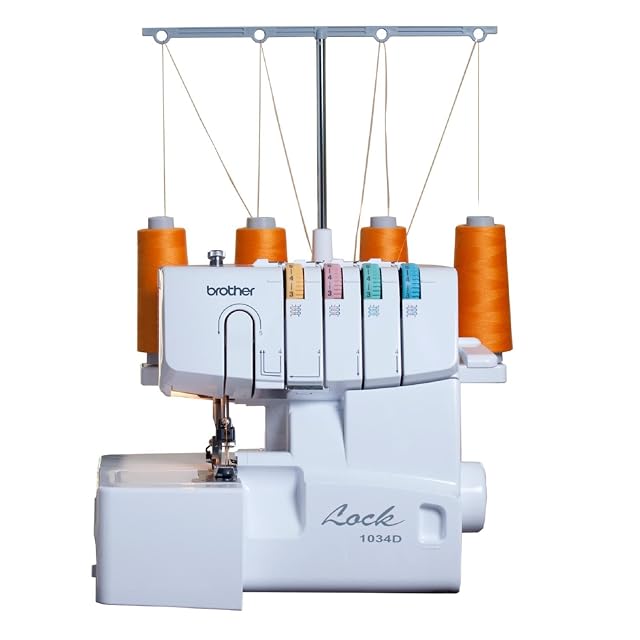
If you sew knits regularly, a serger is faster and gives store-bought seams — see do I need a serger and the Brother 1034D.
What sewers ask us
Which stitch should I use for knits?
A narrow zigzag, around 0.5 to 1 mm wide and 2.5 mm long, or the machine's stretch or lightning stitch. A straight stitch breaks when the seam stretches.
Why does my machine skip stitches on knits?
Usually the wrong needle. A universal or sharp needle can miss loops in knit fabric; a ballpoint, jersey or stretch needle fixes it.
How do I hem knits without a coverstitch?
With a twin needle and a straight stitch, which gives two parallel rows on top and a zigzag underneath that stretches.
Do I need a walking foot for knits?
Not always, but it helps on stretchy or thick knits, feeding both layers evenly so the seam does not wave.
Last reviewed