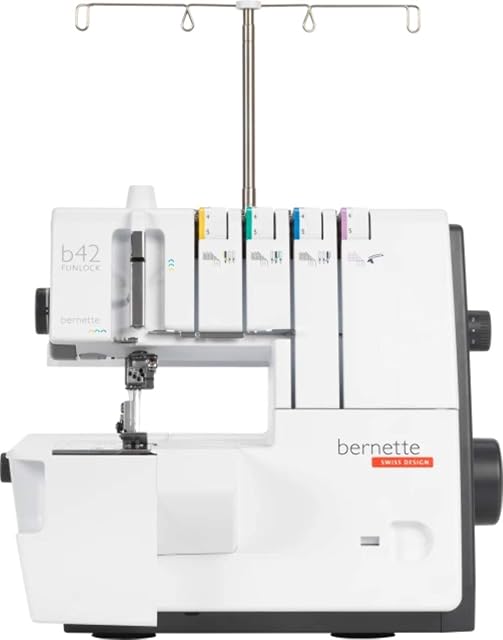
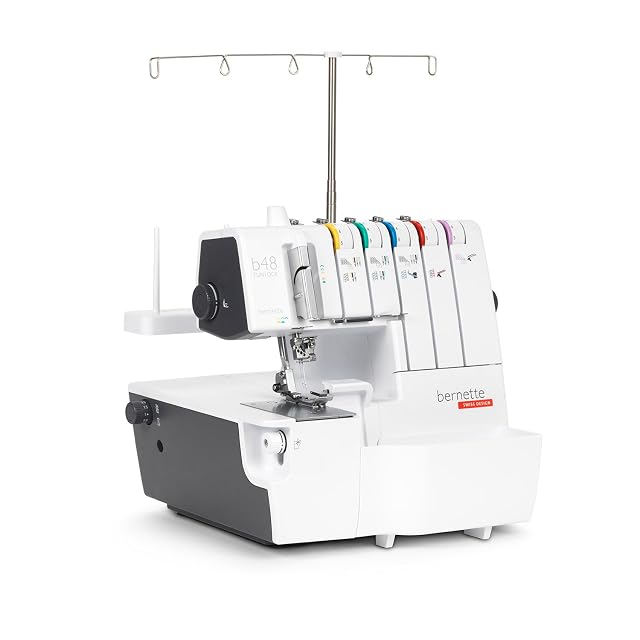
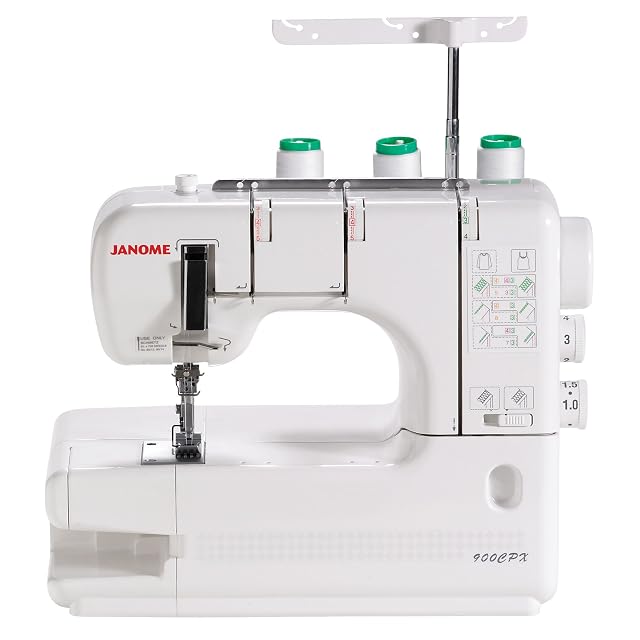
A well-documented coverstitch machine running two to five threads, with a 155 mm throat and differential feed. Five European markets; on amazon.com the search returns an accessory, not the machine.
The bottom line The best-documented coverstitch machine in this batch, provided you are shopping in Europe.
Everything below is either a manufacturer
specification, cited as such, or something we verified ourselves.
What we verified.B075NL9JFL designates this machine on amazon.de,
.fr, .it, .es and .co.uk, confirmed on EAN in each case. Listed weight 8 kg.
What we deliberately did not publish. On amazon.com, our search for this
model returned B07577HF2G — the Brother SA231 dual-function fold binder
“for CV3440 CV3550 Cover Stitch Machines”. That is an accessory that carries the
model number in its title, and it passed every automated check we run because it
is a genuine Brother product whose title contains the model. We caught it by
reading the title, dropped the American market, and left it out of the
references below. American readers get a search rather than a link to a binder.
What Brother states. Two, three, four or five threads. Seven stitch types,
including a triple cover stitch and both wide and narrow top cover stitch.
Colour-coded threading with an aid for the lower looper. A dial for stitch
length, adjustable from 2 mm to 4 mm, and stitch width from 3 mm to 6 mm.
Presser foot lever, adjustable presser foot pressure, differential feed for
elastic and fine fabrics, free arm, and a throat width of 155 mm.
Where we would look before buying. Maximum speed, which Brother does not
publish here, and how the machine handles the crossing point where a coverstitch
hem meets a bulky overlocked side seam.
What we like, and what we don't
Strengths
Seven stitch types including a triple cover stitch — genuinely more than the category norm
A 155 mm throat, which is what lets you turn a sleeve hem
Brother publishes a real specification here, unlike most of this category
Compromises
Not proven on amazon.com — the American search returns a binder accessory
8 kg of single-purpose machine
Specifications
Type
Coverstitch, 2 to 5 thread (manufacturer)
Stitch types
7, including triple cover stitch and wide/narrow top cover stitch (manufacturer)
Stitch length
2 mm – 4 mm (manufacturer)
Stitch width
3 mm – 6 mm (manufacturer)
Throat width
155 mm (manufacturer)
Differential feed
Yes, for elastic and fine fabrics (manufacturer)
Presser foot pressure
Adjustable (manufacturer)
Threading
Colour-coded, with a lower looper threading aid (manufacturer)
Weight
8 kg
The two closest on price
Same category, nearest budget — what else the same money buys.
Turn a hem on something tubular without fighting it. A T-shirt sleeve, a cuff, a child's trouser leg — all of them have to pass around the machine body as you sew, and the distance between the needle and the column is what decides whether that is comfortable or a wrestling match. It is the measurement worth comparing across coverstitch machines, and one of the few Brother publishes.
Is a coverstitch machine better than a twin needle on my sewing machine?
For knits, yes, and the difference is on the underside. A twin needle gives you two parallel rows on the face and a zigzag of bobbin thread beneath, which has limited stretch and can pop when the hem is pulled over a shoulder or a hip. A coverstitch machine lays a looper thread that covers the raw edge and stretches with the fabric. On woven cotton the twin needle is fine; on jersey it is a compromise.
Our score
9.0/ 10
The best-documented coverstitch machine in this batch, provided you are shopping in Europe.
Who this one is for
Hemming knits properly, and anyone who has outgrown a twin needle on a normal machine
If this one is not the right fit
On a tighter budget: Janome CoverPro 900CPX, at 570 £ in the same category. see the review
Value for money
At 600 £, it sits -14 % against the 700 £ median of the 5 models in this category published here.
Price and availability
A reference exists on these Amazon stores: France, Germany, Italy, Spain, United Kingdom. Listed is not the same as in stock — availability changes daily.
Details checked on August 11, 2026.
Sources
Specifications: manufacturer sheet and Amazon product page. Prices and availability: Keepa. No product on this site has been physically tested.
A dedicated coverstitch machine — not a combination unit — with a separate needle threader and a looper threading mechanism. One reference on all six markets we checked.
Best for: Anyone who already owns an overlocker and wants proper twin-needle hems on knits
Overlock + coverstitch + chainstitch · UK and US only
A combined overlock and coverstitch machine, proven on the UK and US stores only. On the German store the same search returns a set of presser feet, which is the more useful warning.
Best for: A UK or US buyer who wants both operations without two machines on the table
A dedicated coverstitch machine — not an overlocker — on one reference across all six markets. Janome publishes almost nothing about it, and we are not filling the gap from memory.
Best for: Someone who already owns an overlocker and wants twin-needle hems on knits