Skip to content

The best coverstitch machines

A coverstitch makes the twin-needle hem you see on every bought T-shirt. If you already own an overlocker, buy a dedicated machine rather than a combination unit — the changeover is what stops people alternating.

A coverstitch makes the twin-needle hem you see on every bought T-shirt. If you already own an overlocker, buy a dedicated machine rather than a combination unit — the changeover is what stops people alternating.

Which one do you need?

You hem knit garments
A coverstitch gives the professional twin-needle hem that stretches without popping.
You already have an overlocker
A coverstitch is the logical third machine, and a combined machine is a compromise worth understanding.
You sew knits occasionally
A twin needle on your sewing machine gives a reasonable approximation for far less.
You dislike reconfiguring machines
A dedicated coverstitch beats a combined overlocker-coverstitch, because switching modes is genuinely tedious.

Choosing by use

Hemming knits

The main use. The stitch stretches, which is what a straight stitch on jersey does not do.

Necklines and cuffs

Where the professional finish is most visible and where the stretch matters most.

Decorative topstitching

Where the chain stitch on the underside becomes a design feature.

Activewear

Where flatlock seams and stretch are functional requirements rather than aesthetics.

The criteria that actually matter

Dedicated or combined
A combined machine saves space and money but switching between overlock and coverstitch takes time. If you switch often, that time is the whole story.
Number of needle positions
Two needles for a narrow or wide cover, three for a triple cover. It decides which hem widths you can produce.
Differential feed
As on an overlocker, it prevents wavy hems on stretchy fabric. It is not optional for knits.
Free arm
For hemming sleeves and cuffs in the round. Without one, small circumferences become awkward.
How you release the fabric
Coverstitch machines do not chain off like overlockers. How you remove work without unravelling it is a real usability point.

Which criterion for which use

Your workThe machineThe consideration
Regular knit hemsA dedicated coverstitchSpace and cost
Occasional knitsA twin needle on your machineLess stretch
Limited spaceA combined machineSwitching modes takes time
Sleeves and cuffsA free armSewing in the round

Mistakes to avoid

Pulling the work out backwards
Coverstitch seams unravel if released wrongly. There is a correct sequence and the manual describes it.
Skipping the stabiliser
Knit hems stretch as you sew them. A stabiliser tape or interfacing keeps the hem flat and is standard practice.
Expecting it to cut
A coverstitch machine does not trim like an overlocker. The edge is finished separately or left raw inside.
Buying a combined machine and switching constantly
If you alternate frequently, the reconfiguration time becomes the dominant experience of owning it.

Choosing by profile

The knitwear maker
Hems jersey regularly and wants a finish a sewing machine cannot produce.
The occasional knit sewer
Is well served by a twin needle and a stabiliser.
The space-limited sewer
Considers a combined machine, understanding the switching cost.

Upkeep and how long it lasts

Coverstitch machines are sensitive to thread quality and tension and produce plenty of lint from knit fabric. A machine that has started skipping stitches usually has a blunt needle or lint under the plate rather than a fault.

  • Use good quality thread; these machines are unforgiving of cheap thread.
  • Change needles regularly and use needles suited to knits.
  • Clean lint from the needle plate and looper area after each session.
  • Keep a record of tension settings that worked for particular fabrics.

Safety

Multiple needles at speed.

  • Unplug before changing needles; there are several and it takes time.
  • Keep fingers clear of the needle bar, which covers a wider area than a single needle.
  • Close all covers before running.
  • Do not force stretchy fabric through; guide it and let the feed work.

What we recommend, and why

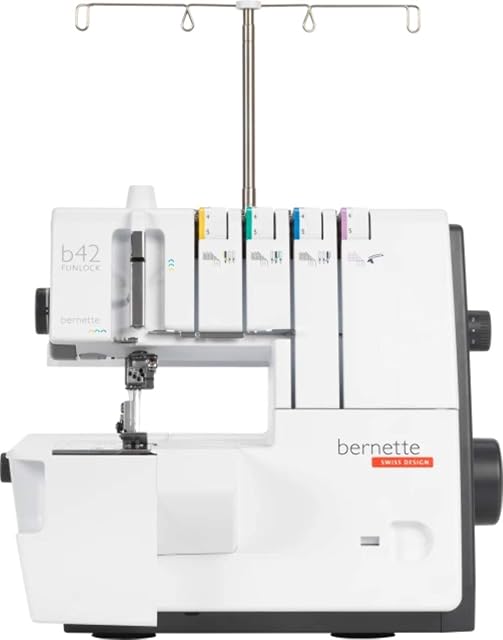
  1. Bernette b42 Funlock

    Coverstitch · looper threader · LED

    A dedicated coverstitch machine — not a combination unit — with a separate needle threader and a looper threading mechanism. One reference on all six markets we checked.

    Best for: Anyone who already owns an overlocker and wants proper twin-needle hems on knits

    8.3/10

    ≈ $700 / £570 / 650 €

  2. Juki MCS-1500

    3 needles · 1,350 spm · colour-coded threading

    A cover and chain stitch machine with three needles, colour-coded threading guides and a stated 1,350 stitches per minute. Present on five of the six markets we checked — not Spain.

    Best for: Knit garment hems, and the occasional chain stitch for jeans-style seams

    7.8/10

    ≈ $800 / £825 / 1020 €

Questions people actually ask

Can I get the same result with a twin needle?

Close, on a normal sewing machine, and for a fraction of the cost. The top looks the same; underneath you get a zigzag rather than a proper chain stitch, so it is less elastic and less durable. For occasional hems a twin needle is the sensible answer.

Why do coverstitch hems tunnel?

Too much tension pulling the two rows together. Reduce top tension, lengthen the stitch slightly and support the fabric with a strip of stabiliser.

What does a coverstitch machine do?

It produces the stretchy twin-needle hem seen on ready-made knitwear, with a chain stitch on the underside. It is the finish a straight stitch cannot give on jersey.

Dedicated or combined with an overlocker?

Combined saves space and money; dedicated saves the reconfiguration time. If you alternate often, that time dominates the experience.

Why does my hem go wavy?

Usually differential feed not adjusted, or no stabiliser. Both are standard practice on knit hems rather than fixes for a fault.

How do I finish a coverstitch seam?

There is a specific release sequence, because pulling the work out wrongly unravels the stitch. The manual describes it and it is worth learning early.

Does it trim the fabric?

No. Unlike an overlocker it has no knife. The edge is finished separately or left as it is inside the garment.

Which needles does it take?

Needles suited to knits, in the system the maker specifies. Using the wrong system is a common cause of skipped stitches on these machines.

Why each one, and for whom

Bernette b42 Funlock · $700

For : Anyone who already owns an overlocker and wants proper twin-needle hems on knits

Main strength : Dedicated machine — no conversion time between overlocking and hemming

Main limitation : A second machine on the table, and 8.6 kg of it

Read the full review →

Juki MCS-1500 · $800

For : Knit garment hems, and the occasional chain stitch for jeans-style seams

Main strength : Colour-coded threading guides — the single feature that decides whether this class of machine gets used

Main limitation : Not listed on amazon.es

Read the full review →

What you will need with it

Consumables and protective gear from the same aisle, at the price we recorded. Check compatibility with the model you choose before ordering: it depends on the fitting and the part number, which the product page states.

Deciding in one line

Useful comparisons

Head-to-heads already published between two models from this guide or this aisle.

How this guide is built

The models here come from the catalogue of this site. Specifications are those published by the manufacturer and on the Amazon product page; prices are what Keepa reported on the date below, and both move. The ranking uses declared specifications, the balance of stated strengths and limitations, and price. No product on this site has been physically tested, and nothing here claims otherwise.

Last checked on

The tool we use ourselves

Chosen your machine? Now buy it at the right price.

Sewing machines and overlockers swing by a hundred euros or more across the year, and the biggest "discounts" often land at prices the same model sold for six weeks earlier. UniverTrack tracks the real price history across retailers, spots fake reductions, and alerts you when it is genuinely the moment to buy.

Real price historyBuy-now alertsAI buying assistant
Try free for 14 days →
No commitment · Cancel in one click · 5 languages